The Twin Paradox Explained Simply
The twin paradox explained simply: why one traveling twin ages less, why it is not a real contradiction, and what time dilation means.
The twin paradox is one of the most famous ideas in relativity because it sounds impossible: one twin flies through space at high speed, comes back, and is younger than the twin who stayed home.
It feels like a contradiction at first. But in relativity, it is not actually a paradox. It is a clue that time depends on the path you take through spacetime.
Quick answer
The twin paradox says that if one twin travels at very high speed through space and returns, that traveling twin can be younger than the twin who stayed on Earth. It is not a true contradiction because the twins do not have identical experiences: the traveling twin accelerates, turns around, and changes reference frames.
The basic twin paradox story
Imagine two twins, Ava and Ben.
Ava stays on Earth. Ben gets in a spaceship and travels away from Earth at a large fraction of the speed of light. After some time, Ben turns around and comes back.
When Ben returns, he has aged less than Ava.
That is the twin paradox.
The surprising part is not just that Ben ages less. The confusing part is that motion is relative. From Ben’s point of view, couldn’t he say Earth moved away and came back? Shouldn’t Ava be younger instead?
That question is why the thought experiment is called a paradox.
The key idea: the trip is not symmetric
The solution is that the twins’ situations are not the same.
Ava stays in one main inertial frame, ignoring Earth’s smaller motions for the simplified thought experiment. Ben does not. Ben has to accelerate away, turn around, and accelerate back. That turnaround matters because it changes Ben’s reference frame.
The traveling twin follows a different path through spacetime, and that path contains less elapsed proper time.
In plain English: Ben’s route through the universe is different, so Ben experiences less time.
What is time dilation?
Time dilation means that time can pass at different rates for observers in different situations.
In special relativity, a moving clock is measured to tick slower relative to an observer who is not moving with it. This is not because the clock is broken. It is because time and space are connected.
At everyday speeds, the effect is so tiny that you never notice it. At speeds close to the speed of light, the effect becomes large.
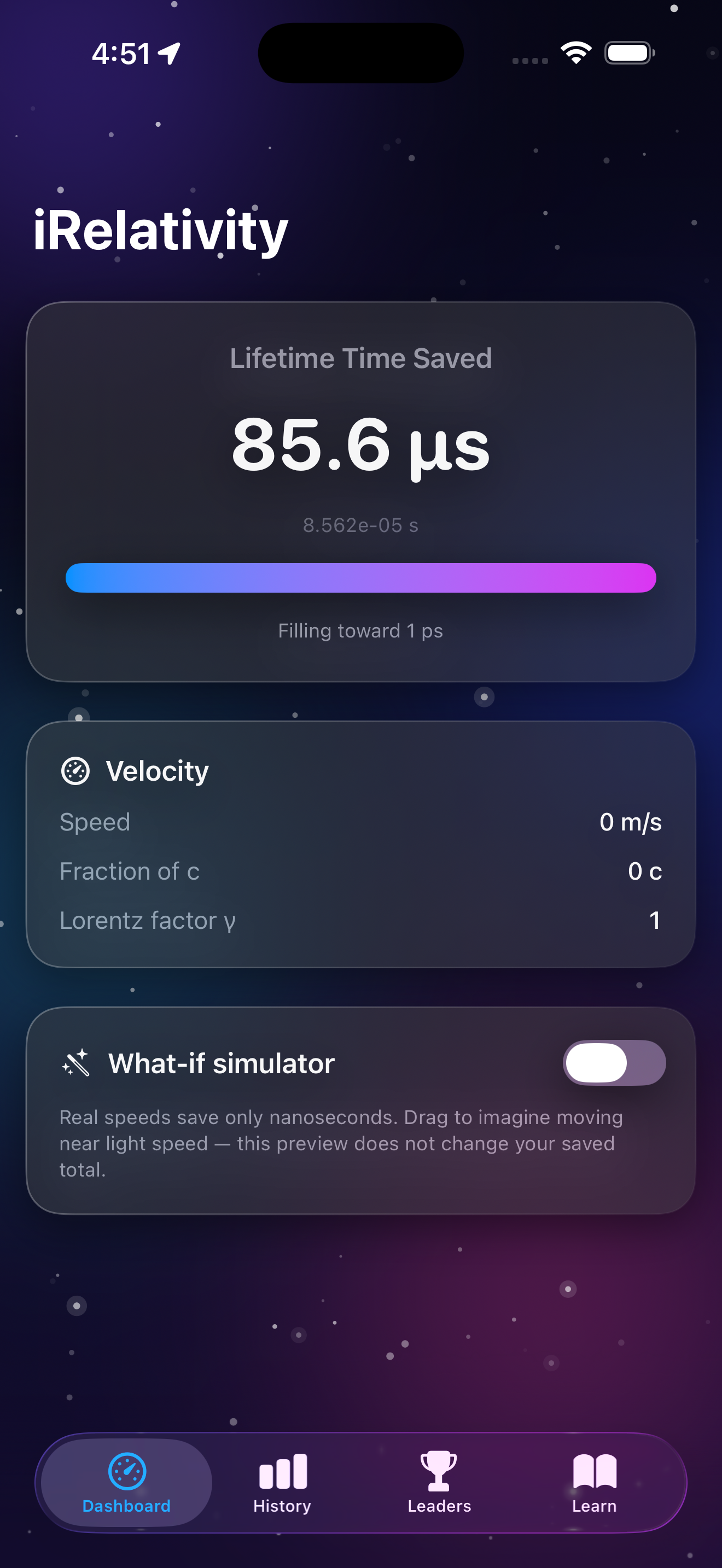
iRelativity is a free iOS app that helps make the tiny everyday version visible. It uses your real GPS speed to calculate special-relativity time dilation live, and it includes a what-if simulator so you can compare normal speeds with extreme ones.
Why both twins cannot simply say the other is younger
This is the heart of the confusion.
During the outbound part of the trip, each twin can describe the other as moving. During the inbound part, the same kind of relative-motion thinking applies. But Ben’s full journey includes a turnaround. That turnaround switches Ben from one frame of reference to another.
Because Ben changes frames, the situation is not mirror-image equal.
Ava does not need to fire rockets, turn around, and come back to Ben. Ben does. That difference breaks the symmetry.
A simple map analogy
Imagine two people walking from the same starting point to the same ending point. One person walks straight. The other person takes a long angled route.
They start together and end together, but their paths are different lengths.
In relativity, the “length” of a path through spacetime determines how much time a traveler experiences. The analogy is not perfect because spacetime geometry is different from a normal map, but it helps: different paths can produce different amounts of elapsed time.
Is acceleration the only reason?
Acceleration is important because it explains why the twins’ viewpoints are not symmetric. However, the aging difference can be calculated by comparing the spacetime paths. The traveling twin’s path has less proper time.
So it is not simply “acceleration makes you younger” in a basic everyday sense. The full journey matters: high-speed travel away, turnaround, and high-speed travel back.
Could this happen in real life?
In principle, yes. In practice, sending a human twin near light speed is far beyond current everyday travel.
But time dilation itself is real and measured. Precise clocks flown on aircraft, clocks at different altitudes, fast-moving particles, and satellite systems all show that time is affected by motion and gravity.
Astronauts also experience tiny time differences compared with people on Earth, but the effect at current spaceflight speeds is very small.
Why the speed of light matters
The twin paradox becomes dramatic only at extremely high speeds. The closer the spaceship gets to the speed of light, the more time dilation matters.
At normal speeds:
- Walking: effectively zero noticeable difference
- Driving: still incredibly tiny
- Flying: measurable with precise clocks, not your body
- Orbiting Earth: small but real
- Near light speed: huge difference
That is why relativity feels strange. Human intuition was built at slow speeds, where the effect is hidden.
What the traveling twin would experience
Ben, the traveling twin, would not feel time “slowing down” inside the spaceship. His heartbeat, thoughts, clocks, and meals would all feel normal to him.
The difference appears when comparing Ben’s elapsed time with Ava’s after they reunite.
This is important: time dilation is not a feeling. It is a comparison between measured elapsed times along different paths.
How to explain it in one sentence
The traveling twin ages less because they take a different path through spacetime, including a high-speed journey and a turnaround, so less time passes for them than for the twin who stays home.
That is the simplest accurate version.
Common misunderstandings
“It is just an illusion”
No. Time dilation is not just a visual trick or delay in seeing light. It affects actual elapsed time measured by clocks.
“The spaceship clock is broken”
No. A moving clock is not malfunctioning. It is measuring time correctly along its own path.
“Acceleration alone causes all the aging difference”
Acceleration explains the asymmetry, but the full difference comes from comparing the twins’ complete paths through spacetime.
“This only matters in science fiction”
The dramatic twin story is science-fiction-like, but time dilation is used and measured in real physics and technology.
Try the everyday version
You cannot travel near light speed with your phone, but you can still explore the concept. iRelativity uses GPS speed to calculate your time dilation and keeps a lifetime total. The numbers at normal speeds are tiny, which helps show why relativity is real but usually invisible.
The what-if simulator is especially useful for understanding the twin paradox because you can compare ordinary speeds with extreme speeds.
Final thoughts
The twin paradox sounds like a contradiction because it challenges the everyday idea that time is the same for everyone. Relativity says something deeper: time depends on motion, gravity, and the path taken through spacetime.
One twin stays on Earth. One twin takes a high-speed trip, turns around, and comes home. Same reunion, different paths, different elapsed time. That is not a paradox once you see the asymmetry.
Frequently asked questions
What is the twin paradox in simple terms? +
The twin paradox is a thought experiment where one twin travels through space at very high speed and returns younger than the twin who stayed on Earth. It seems paradoxical because each twin might think the other was moving, but the traveling twin changes direction and reference frames.
Why does the traveling twin age less? +
The traveling twin ages less because high-speed motion changes the amount of time experienced along that twin’s path through spacetime. The trip is not symmetric because the traveler accelerates, turns around, and returns.
Is the twin paradox real? +
The twin paradox is a real prediction of relativity, although the classic twin version is a thought experiment. Time dilation has been measured with precise clocks, fast particles, aircraft, and satellites.
Related articles
Does GPS Depend on Relativity?
Does GPS really depend on Einstein’s relativity? Yes. Here is the simple explanation of how time dilation affects satellites.
Read article
How Much Time Do You Actually "Save" by Moving Fast?
Thanks to relativity, every trip you take literally saves you a sliver of time. Here are the real numbers — from walking to highway driving to flying — and how to track your lifetime total.
Read article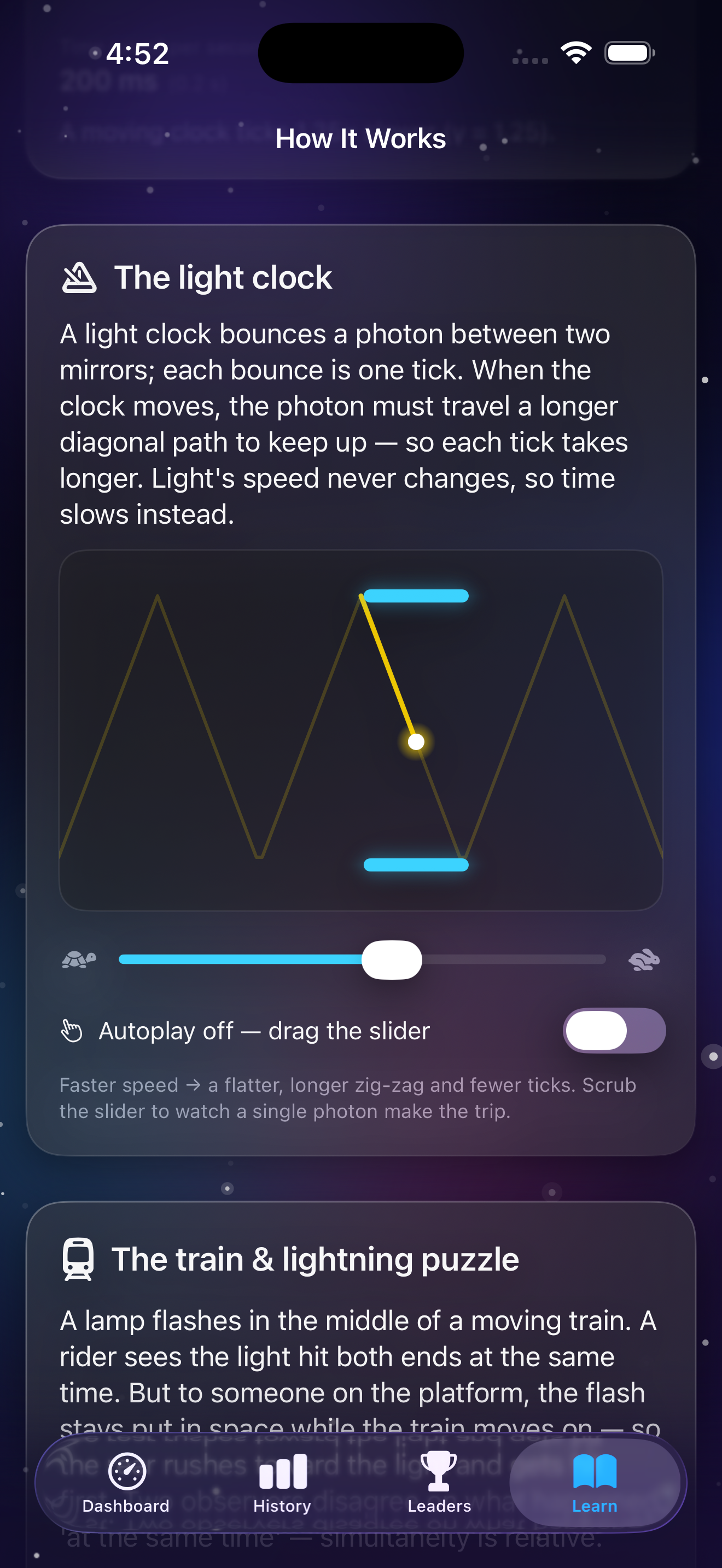
What Is Time Dilation? Special Relativity Explained Simply
Time dilation sounds like science fiction, but it's happening to you right now. Here's a clear, jargon-free explanation of special relativity — and how you can watch it happen on your own phone.
Read article