How Much Time Do You Actually "Save" by Moving Fast?
Thanks to relativity, every trip you take literally saves you a sliver of time. Here are the real numbers — from walking to highway driving to flying — and how to track your lifetime total.
Here’s a fun and completely true fact: because of special relativity, every trip you take saves you a tiny amount of time. Not metaphorically — literally. The faster you move, the slower your clock ticks relative to someone standing still. Let’s put real numbers on it.
Quick answer
Time dilation is real but tiny at human speeds: about a nanosecond per hour on the highway, a few microseconds on a long flight, and milliseconds over months in orbit. You can track your own running total automatically with iRelativity.
The numbers, from slow to fast
These are order-of-magnitude figures for time “saved” relative to standing still:
| Activity | Speed | Time saved |
|---|---|---|
| Brisk walk | ~3 mph | a few attoseconds per hour |
| City driving | ~30 mph | ~0.2 nanoseconds per hour |
| Highway driving | ~65 mph | ~1 nanosecond per hour |
| Commercial flight | ~575 mph | ~80 nanoseconds per hour |
| ISS orbit | ~17,500 mph | ~25 microseconds per day |
A nanosecond is a billionth of a second, so a lifetime of highway commuting might net you a fraction of a microsecond. You will never notice it. But it’s genuinely happening, and the math is identical to what keeps GPS accurate.
Why it’s bigger than it sounds
Two reasons this matters more than the tiny numbers suggest:
- It proves the universe is stranger than intuition. Time isn’t a fixed background clock; it depends on how you move through space. That’s profound, and it’s measurable with everyday-ish speeds.
- It scales explosively. The effect grows with the Lorentz factor, which barely budges at car speeds but skyrockets as you approach the speed of light. At 90% of light speed, one year for you would be over two years for someone you left behind.
Track your own lifetime total
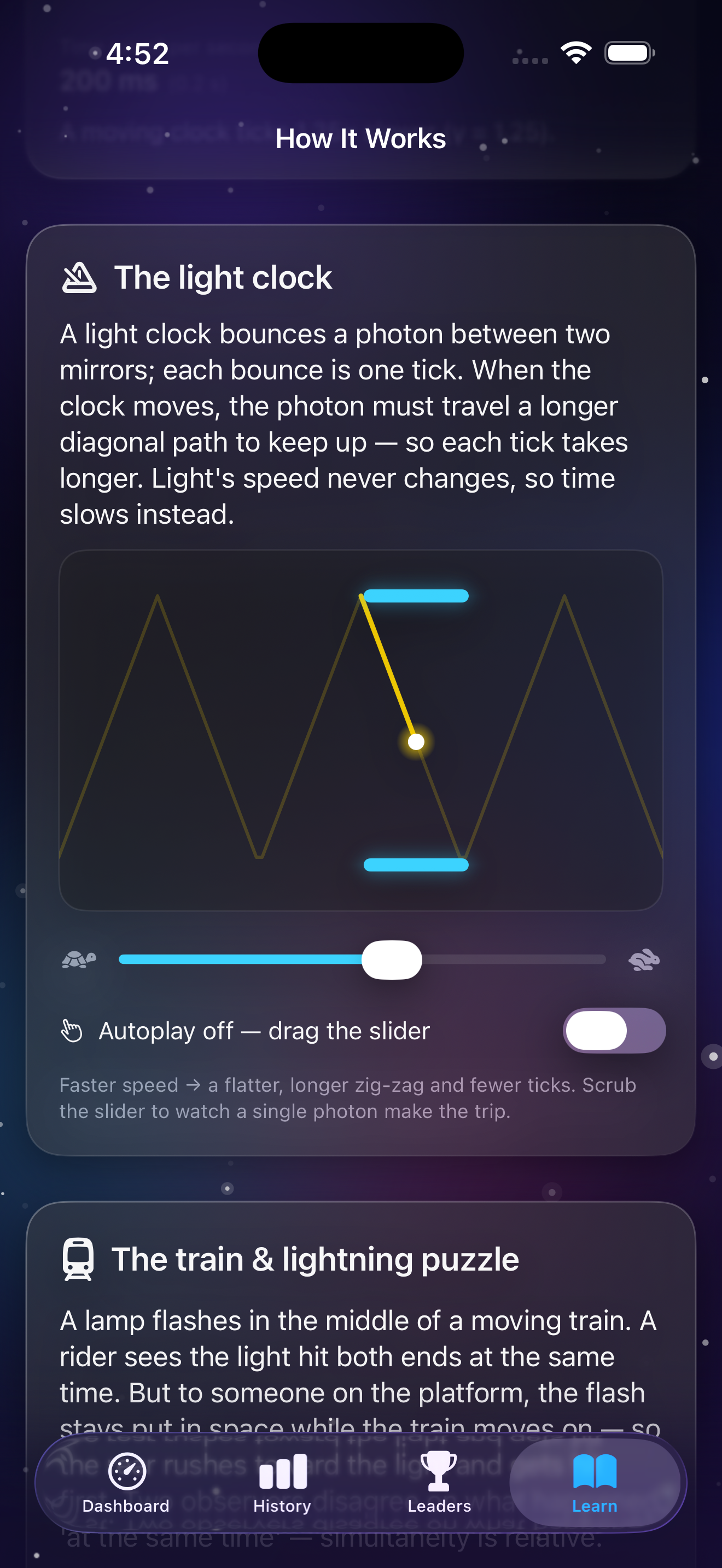
Watching these numbers add up is oddly satisfying — which is the whole reason we built iRelativity. It uses your phone’s real GPS velocity to compute your time dilation live via the Lorentz equation, then keeps a lifetime total across every walk, drive, and flight, displayed in the most readable unit from femtoseconds up to seconds. You get a daily history chart, a Game Center leaderboard to compare with other travelers, and a what-if simulator to see what 0.9c would feel like.
It turns an invisible physics effect into a personal counter that ticks up every time you move. See how much time you’ve saved.
Frequently asked questions
How much time does time dilation save at highway speed? +
At about 65 mph, time dilation saves you roughly a nanosecond — a billionth of a second — per hour of driving. It's minuscule, but it accumulates across every trip you ever take.
Do astronauts age slower? +
Slightly, yes. Astronauts on the ISS travel fast enough that, after long missions, they've aged a few milliseconds less than they would have on the ground. It's small, but it's been measured.
Related articles
What Is Time Dilation? Special Relativity Explained Simply
Time dilation sounds like science fiction, but it's happening to you right now. Here's a clear, jargon-free explanation of special relativity — and how you can watch it happen on your own phone.
Read article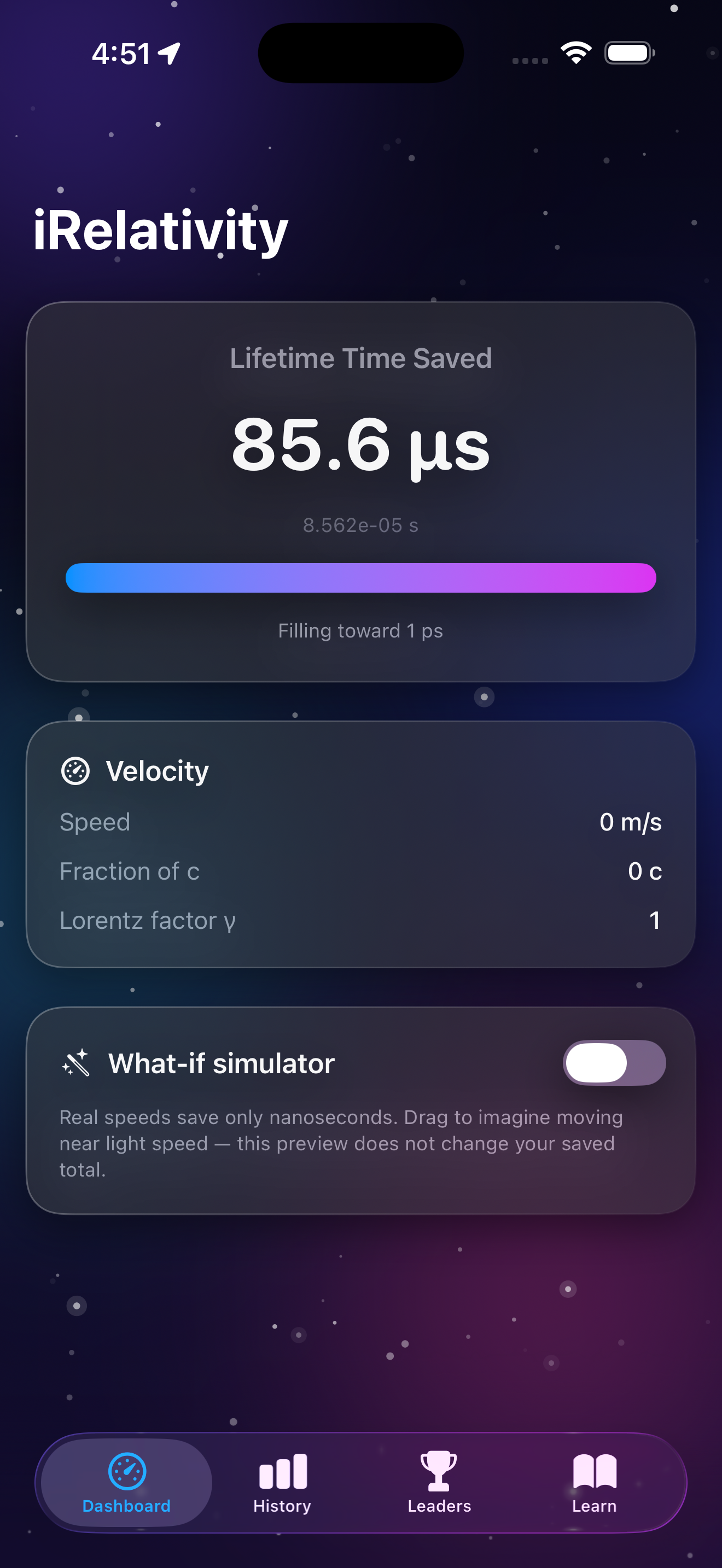
Does GPS Depend on Relativity?
Does GPS really depend on Einstein’s relativity? Yes. Here is the simple explanation of how time dilation affects satellites.
Read article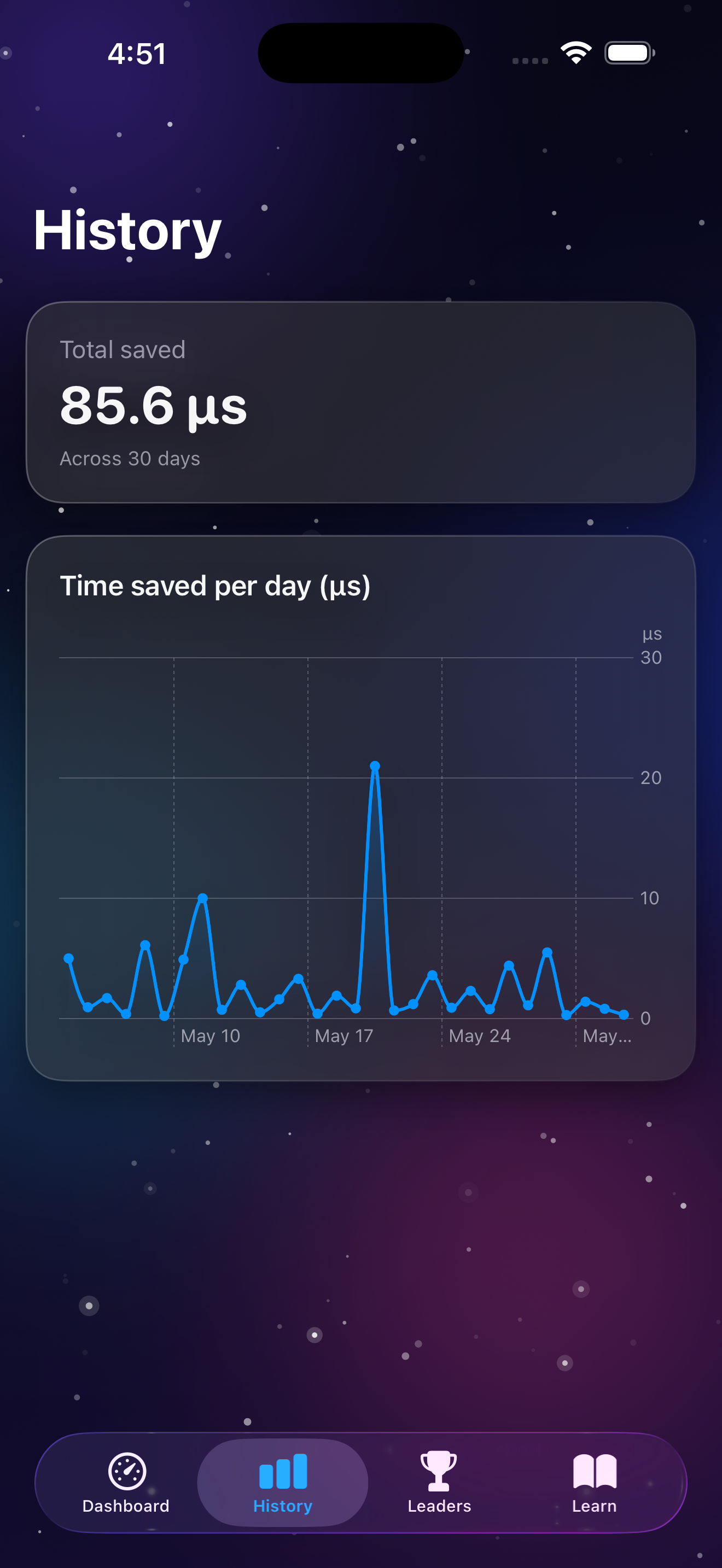
The Twin Paradox Explained Simply
The twin paradox explained simply: why one traveling twin ages less, why it is not a real contradiction, and what time dilation means.
Read article