Does GPS Depend on Relativity?
Does GPS really depend on Einstein’s relativity? Yes. Here is the simple explanation of how time dilation affects satellites.
GPS feels ordinary now. Your phone opens a map, finds your location, and gives directions within seconds. But behind that everyday convenience is a surprising fact: GPS has to account for Einstein’s relativity.
Without relativistic clock corrections, GPS would become inaccurate very quickly.
Quick answer
Yes, GPS really depends on Einstein’s relativity. GPS satellites use extremely precise clocks, and those clocks tick at different rates than clocks on Earth because the satellites are moving fast and are higher in Earth’s gravitational field.
How GPS finds your location
GPS does not “see” where you are. It calculates your position using time.
GPS satellites broadcast signals that include the time the signal was sent and information about the satellite’s position. Your phone or GPS receiver compares that send time to the receive time. Since radio signals travel at the speed of light, the receiver can estimate how far away each satellite is.
With signals from multiple satellites, your device can solve for your location.
That means GPS accuracy depends on timing. Very, very precise timing.
Why tiny timing errors matter
Light travels extremely fast. A timing error of just one microsecond, which is one millionth of a second, corresponds to roughly 300 meters of distance.
So if satellite clocks drift even slightly, your location calculation can drift too. GPS needs clocks that stay synchronized well enough for useful navigation.
This is where relativity comes in.
Special relativity: moving clocks tick slower
Einstein’s special relativity says that motion affects time. A clock moving relative to you ticks slightly slower from your frame of reference.
GPS satellites orbit Earth at high speed. Because they are moving quickly compared with clocks on the ground, their clocks experience a small special-relativity effect: they tick slower than Earth-based clocks.
This effect is tiny, but GPS is sensitive enough that tiny matters.
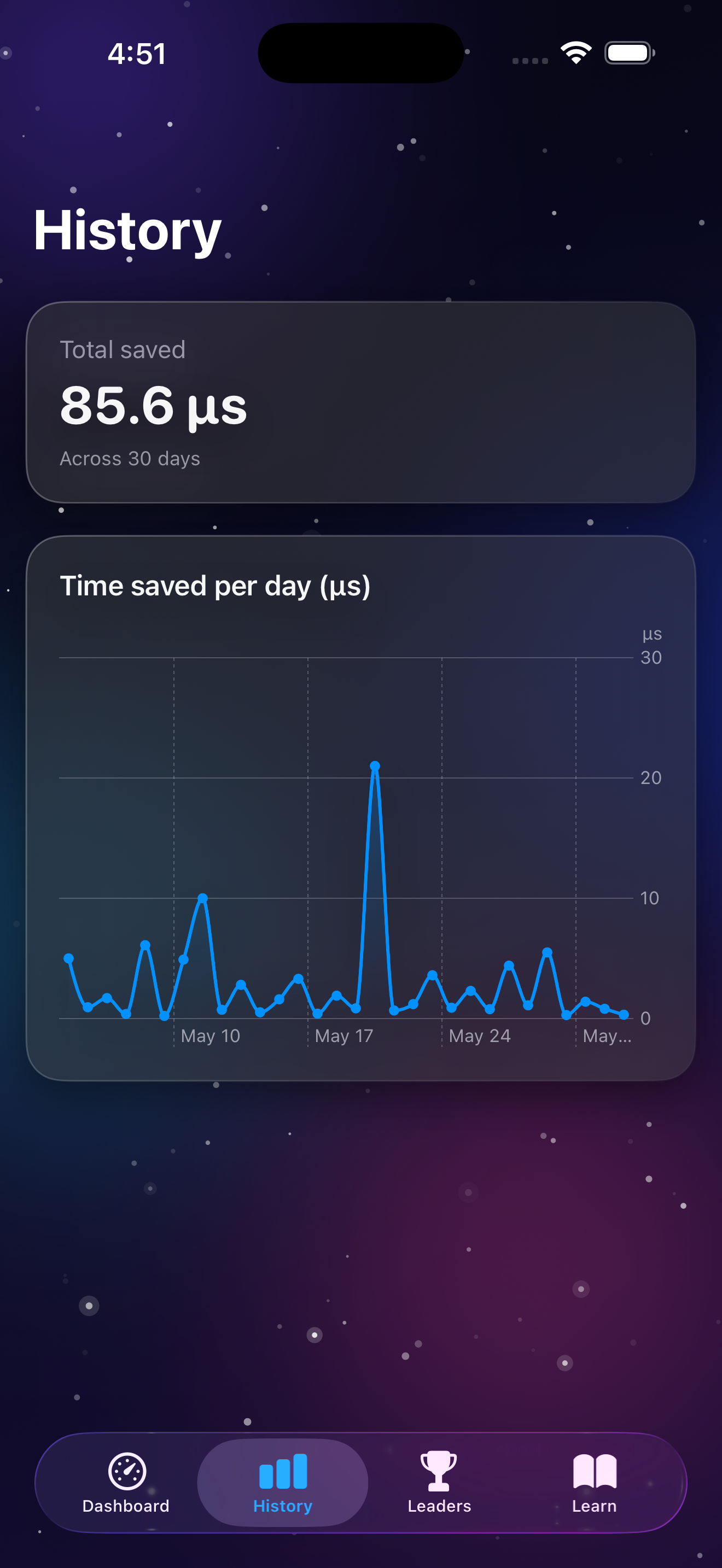
If you want to play with the basic idea using your own movement, iRelativity is a free iOS app that uses your real GPS speed to compute special-relativity time dilation live. At normal human speeds, the effect is extremely small, which is part of what makes the comparison interesting.
General relativity: gravity also affects time
Einstein’s general relativity adds another effect: gravity affects the rate at which time passes.
Clocks deeper in a gravitational field tick slightly slower than clocks higher up. GPS satellites are far above Earth’s surface, where Earth’s gravity is weaker than it is on the ground. Because of that, satellite clocks tick faster than comparable clocks on Earth.
So two effects are happening at once:
- Their orbital motion makes their clocks tick slower.
- Their higher altitude makes their clocks tick faster.
For GPS satellites, the gravity effect is larger than the motion effect, so the net result is that satellite clocks tick faster than clocks on Earth unless corrected.
Why GPS corrections are necessary
GPS is a timing system before it is a map system. If the clocks are wrong, the distances are wrong. If the distances are wrong, the position is wrong.
Relativistic effects do not make GPS impossible. They just have to be included in the system design. Satellite clocks are adjusted and GPS calculations account for the difference between satellite time and Earth-based receiver time.
This is a great example of physics becoming engineering. Relativity is not only an abstract theory about spaceships and black holes. It is part of a technology millions of people use every day.
Does your phone calculate relativity?
Your phone does not personally reinvent Einstein’s equations every time you open a maps app. The GPS system is designed so that satellite timing, orbital data, and receiver calculations work together with necessary corrections included.
The important point is that the system has to account for relativistic time differences somewhere. Otherwise, the timing would not stay accurate enough for reliable positioning.
Why satellites are different from cars and airplanes
You might wonder: if relativity affects GPS satellites, does it affect you in a car?
Technically, yes. Anything moving relative to something else has a special-relativity time difference. But at normal speeds, the effect is incredibly small.
A car, plane, or runner is moving far slower than a GPS satellite. That means the time dilation is real but not noticeable in daily life.
This is exactly the kind of scale difference iRelativity is designed to make visible. It uses your GPS speed to show the calculated effect live, while also tracking lifetime totals and offering a what-if simulator for faster speeds.
Special relativity vs general relativity in GPS
It helps to separate the two ideas:
Special relativity
Special relativity deals with motion. Because GPS satellites move quickly, their clocks tick a bit slower relative to clocks on Earth.
General relativity
General relativity deals with gravity and spacetime. Because GPS satellites are high above Earth, where gravity is weaker, their clocks tick faster relative to clocks on Earth.
Both effects matter. GPS accuracy comes from handling the combination.
Is GPS “proof” of relativity?
GPS is one of the most practical everyday examples of relativity, but science does not usually rest on one proof. Relativity has been tested in many ways, including precise clock experiments, particle physics, astronomy, and observations of light bending near massive objects.
GPS is powerful because it makes the theory feel concrete. You do not need a black hole to see why time matters. You just need a satellite clock and a receiver that depends on nanosecond-level timing.
A simple analogy
Imagine two musicians trying to play together from far away. If their clocks are even slightly out of sync, the music falls apart. GPS is similar: satellites and receivers need timing to line up.
Relativity changes the satellite clocks just enough that the system must compensate. Not because the effect is huge by everyday standards, but because GPS requires extreme precision.
Why this matters for learning physics
Relativity is often introduced with strange examples: twins aging differently, trains moving near light speed, or astronauts returning younger. Those are useful, but GPS shows the same core idea in a real system.
It teaches three important lessons:
- Time is not perfectly universal.
- Motion affects time.
- Gravity affects time.
- Tiny effects can matter when measurement is precise enough.
That is a much better starting point than treating relativity like science fiction.
Final thoughts
GPS really does depend on Einstein’s relativity. Satellite clocks are affected by both motion and gravity, and the system has to account for those effects to keep location measurements accurate.
For everyday life, relativity usually feels invisible. For GPS, it is part of the machinery. And once you understand that, Einstein’s ideas feel less like distant theory and more like something quietly helping your phone know where you are.
Frequently asked questions
Does GPS really use Einstein’s relativity? +
Yes. GPS satellites carry precise atomic clocks, and those clocks tick at slightly different rates than clocks on Earth because of special and general relativity. GPS systems account for these timing differences so location calculations stay accurate.
Why does relativity matter for GPS? +
GPS works by measuring how long signals take to travel from satellites to your receiver. Because light travels about 300,000 kilometers per second, even tiny clock errors can become large position errors if relativity is ignored.
Is GPS proof of relativity? +
GPS is a practical technology that relies on relativistic corrections, but it is not the only evidence for relativity. Einstein’s theories are also supported by particle experiments, atomic clocks, gravitational lensing, and many other observations.
Related articles
The Twin Paradox Explained Simply
The twin paradox explained simply: why one traveling twin ages less, why it is not a real contradiction, and what time dilation means.
Read article How Much Time Do You Actually "Save" by Moving Fast?
Thanks to relativity, every trip you take literally saves you a sliver of time. Here are the real numbers — from walking to highway driving to flying — and how to track your lifetime total.
Read article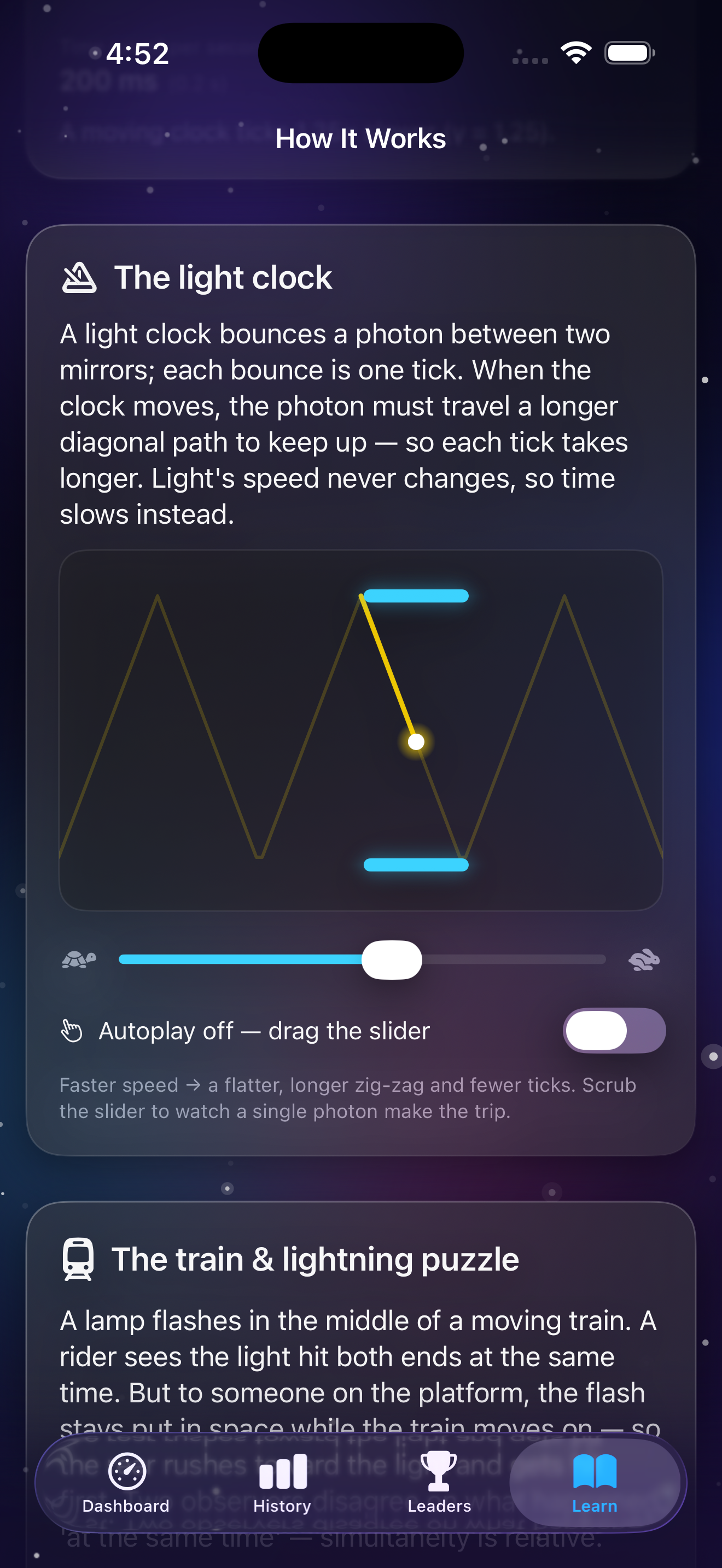
What Is Time Dilation? Special Relativity Explained Simply
Time dilation sounds like science fiction, but it's happening to you right now. Here's a clear, jargon-free explanation of special relativity — and how you can watch it happen on your own phone.
Read article