Do Daily Brain Games Actually Make You Smarter?
Can a few minutes of daily brain games really sharpen your mind? Here's what the science says about memory, recall, and habit — and how to pick a daily game that's actually worth your time.
“Train your brain in 5 minutes a day!” is one of the most over-promised claims in the app store. So let’s be honest about what daily brain games can and can’t do — and how to choose one that’s genuinely worth the few minutes.
Quick answer
Brain games won’t turn you into a genius, and most “brain training” mainly makes you better at that one game. But daily games built around real recall — history, vocabulary, facts — do reinforce knowledge through repetition, and the daily habit supports focus and routine. The trick is picking games grounded in real knowledge, like Yearly.
What the research actually says
The big takeaway from years of “brain training” studies is the transfer problem: practicing a memory game tends to make you better at that game, not at memory in general. Abstract drills — matching shapes, tapping sequences — rarely improve everyday cognition.
That doesn’t make daily games worthless. It means you should pick the right kind.
The kind of daily game that’s worth it
Look for games that involve:
- Real knowledge. Recalling actual facts (a historical year, a word, a place) reinforces information you can use elsewhere.
- Active recall. Retrieving an answer from memory strengthens it far more than passively reviewing.
- Spaced repetition. Encountering related facts day after day is how knowledge sticks long-term.
- A reason to return. Streaks and stats turn “I should” into “I want to.”
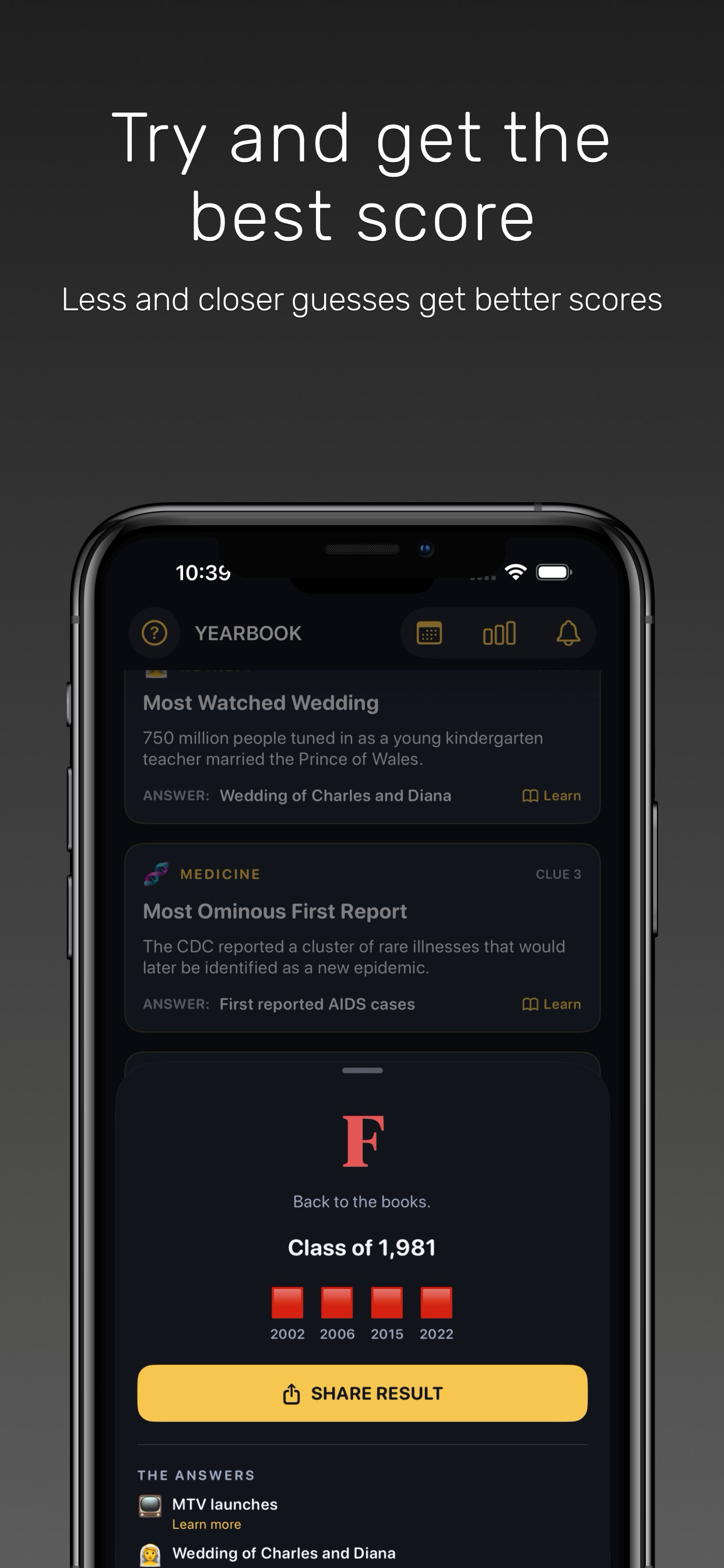
A daily history game like Yearly checks all four boxes: you actively recall (or reason out) a year from real-world clues across politics, pop culture, sports, and science. Over weeks, you naturally absorb a timeline of events — and the “Learn More” links let you dig deeper into anything you missed.
The underrated benefit: the habit itself
Even setting aside raw cognition, a tiny daily ritual has real value. It’s a gentle, screen-light way to start the day with focus instead of doomscrolling. A single puzzle, a clear win or loss, and you move on — no infinite feed pulling you back.
How to get the most out of it
- Attach it to an existing habit — coffee, commute, lunch break.
- Keep it short. One puzzle. Five minutes. Done.
- Read the explanations. That’s where the actual learning happens.
- Protect your streak. It’s the simplest, most reliable motivator there is.
If you want a daily game that’s actually built on real knowledge — and teaches you a little history every morning — try Yearly.
Frequently asked questions
Do brain-training games actually work? +
The honest answer: you mostly get better at the specific game. But daily games that involve real recall — facts, vocabulary, history — do reinforce knowledge through spaced repetition, and the habit itself supports focus and routine. Choose games built on real knowledge, not abstract drills.
How long should you play brain games each day? +
Five to ten minutes is plenty. The benefit comes from consistency, not duration. One focused puzzle a day beats an hour-long binge once a week.
Related articles
The Best Daily Puzzle Games Like Wordle to Play in 2026
Loved Wordle but want something new? Here are the best daily puzzle games for 2026 — quick, once-a-day brain teasers that build a streak — including a history-guessing game you haven't tried yet.
Read article Daily Games for Your Morning Commute
Daily games to play on your morning commute that are quick, low-stress, and easy to enjoy in short sessions.
Read article
How to Get Better at History Trivia
How to get better at history trivia using timelines, context clues, smarter guessing, and daily practice.
Read article